


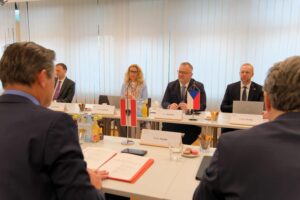
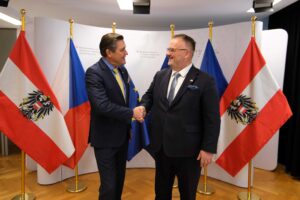
Czech Minister of Transport Ivan Bednárik met with Peter Hanke, Austria’s Federal Minister for Innovation, Mobility and Infrastructure, in Vienna. The main topics of their discussions included the development of cross-border transport infrastructure, cooperation on the planning of high-speed rail, its financing through European funding programmes, and the construction of key road links.
At the conclusion of the meeting, the two ministers signed a memorandum confirming both countries’ commitment to continuing close cooperation on the development of cross-border railway infrastructure.
“Developing cross-border transport infrastructure with Austria is crucial for citizens and the economies of both countries. We still lack a motorway connection, and the railway network also faces significant challenges. I briefed the Austrian side on infrastructure projects on our side of the shared border, particularly the final stages of construction of the D3 motorway in South Bohemia, which will allow drivers to travel all the way to Dolní Dvořiště as early as next year. Intensive preparations are also continuing for our second motorway link with Austria, the D52 motorway towards Vienna. This project is explicitly highlighted in the Government’s Policy Statement, and the Directorate of Roads and Motorways plans to begin construction next year on sections outside the Nové Mlýny reservoir,” said Ivan Bednárik, Minister of Transport, outlining the current project timelines.
Federal Minister Peter Hanke provided an update on the completion of the S10 expressway, which is intended to connect with the D3 motorway in South Bohemia. The Freistadt-Nord–Rainbach section is currently under construction and is expected to open to traffic during the coming year. The adjoining section between Rainbach and the state border is still in the planning and preparation phase and is expected to be completed in approximately five years.
“With regard to rail transport, I assured our Austrian colleagues that we regard the Via Vindobona high-speed rail connection (Berlin–Prague–Vienna) as a strategic project of pan-European significance and that it is included in our plans for developing the backbone of the high-speed rail network. We agreed that the European Union’s forthcoming decision on the shape of the multiannual financial framework for the period after 2028 will be decisive in determining the timetable for project preparation and subsequent construction. Member States will no longer receive funding for their own projects as a matter of course; instead, projects will have to compete at the European level. Nevertheless, we are convinced that Via Vindobona offers such substantial benefits that it will succeed in this competition and secure an appropriate level of EU co-financing,” Minister Bednárik stated.
In addition to the Via Vindobona high-speed connection, the recently signed memorandum emphasises the modernisation of the Prague–České Budějovice–Linz railway connection and the preparation of the cross-border section between České Budějovice and Linz. The technical parameters of this section are currently being assessed in a joint study by Správa železnic, the Czech railway infrastructure manager, and ÖBB, the Austrian Federal Railways. The discussions also covered the modernisation of the Veselí nad Lužnicí–České Velenice–Gmünd–Vienna line. Once completed, the project will increase capacity for both passenger and freight services and provide an important alternative diversion route.
The discussions also addressed the competitiveness of rail freight transport and the need for a coordinated approach at European Union level. Minister Bednárik presented the Czech initiative aimed at strengthening the role of rail in freight transport and removing barriers to cross-border rail operations.
At the conclusion of the meeting, the ministers agreed to continue close cooperation on the preparation and implementation of key transport projects between the Czech Republic and Austria.
Source: md.gov.cz